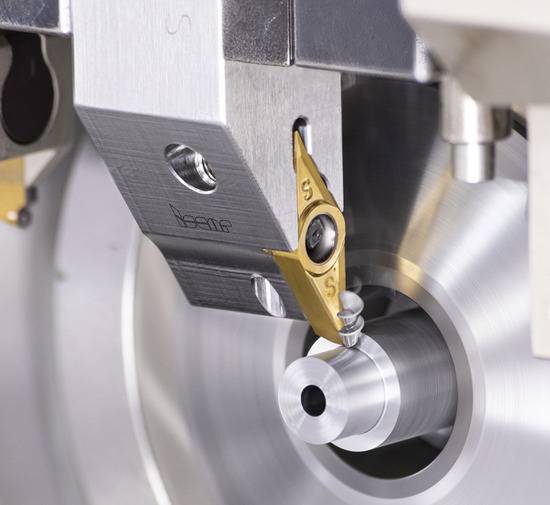
The Real Challenge of Machining Stainless Steel
Why stability becomes even more important when machining difficult materials.
Few materials test a machining process quite like stainless steel.
Its strength, corrosion resistance and durability make it indispensable across industries such as aerospace, medical, energy and general engineering. Yet those same properties also make it one of the most demanding materials to machine consistently.
Unlike more forgiving materials, stainless steel offers very little tolerance for inconsistency. Small changes in cutting conditions, tool engagement or coolant delivery can quickly affect tool life, surface finish and overall process stability.
For manufacturers, success is rarely determined by the cutting tool alone. It is determined by the ability to control the entire machining process.
Heat is the real challenge
One of the defining characteristics of stainless steel is the way it retains heat.
Rather than allowing heat to dissipate into the chip, a significant proportion remains concentrated around the cutting edge. As temperatures increase, tool wear accelerates and machining performance becomes increasingly difficult to maintain.
Managing heat therefore becomes one of the primary objectives when developing a machining strategy.
This requires careful consideration of:
- Cutting parameters
- Tool geometry
- Coating technology
- Coolant delivery
- Chip evacuation
- Machine rigidity
Each element plays a role in maintaining stable cutting conditions throughout the machining cycle.
Small inconsistencies become significant
Processes that perform reliably in carbon steel or aluminium may become unstable when applied directly to stainless steel.
Slight vibration, inconsistent feed rates or poor workholding can encourage work hardening, increasing cutting forces and placing greater demands on both the tooling and the machine.
Once instability begins, performance often deteriorates rapidly.
Preventing these issues is considerably more effective than attempting to correct them once production is underway.
Engineering knowledge makes the difference
Machining stainless steel successfully requires more than selecting a recommended insert or cutting speed.
It demands an understanding of how the material behaves under real production conditions.
Helix engineers work alongside manufacturers to evaluate the complete machining environment, considering factors such as component geometry, machine capability, coolant strategy and production objectives before recommending an approach.
This practical engineering perspective helps ensure machining strategies are designed around stability rather than simply productivity.
Reliability improves competitiveness
Stable machining processes provide commercial as well as technical benefits.
Predictable tool life allows more accurate production planning. Consistent surface finishes reduce inspection and rework. Improved process control lowers cost-per-part and increases confidence in delivery performance.
For manufacturers machining stainless steel regularly, these advantages become increasingly significant over time.
Process security builds long-term performance
Manufacturers often focus on achieving the fastest possible cycle time.
However, in difficult materials, sustainable productivity usually comes from maintaining process security rather than operating at the limit.
A stable process that performs consistently across every production run will almost always outperform one that delivers occasional high performance but suffers frequent interruption.
Conclusion
Stainless steel rewards manufacturers who prioritise stability, consistency and engineering discipline.
By understanding how the material behaves and designing machining strategies that control heat, maintain rigidity and minimise variation, manufacturers can improve both productivity and process reliability.
Helix helps manufacturers develop these strategies through practical application expertise and engineering support, ensuring stainless steel becomes an opportunity for competitive advantage rather than a source of operational risk.
Want more practical insights like this?